Every disciplinary case carries an ethical component, which means an ethics assessment has a role in more cases than a board might first assume. The practical question for a board is not whether assessment belongs in a case. It is where the assessment does the most work, and which situations make that value easiest to see.
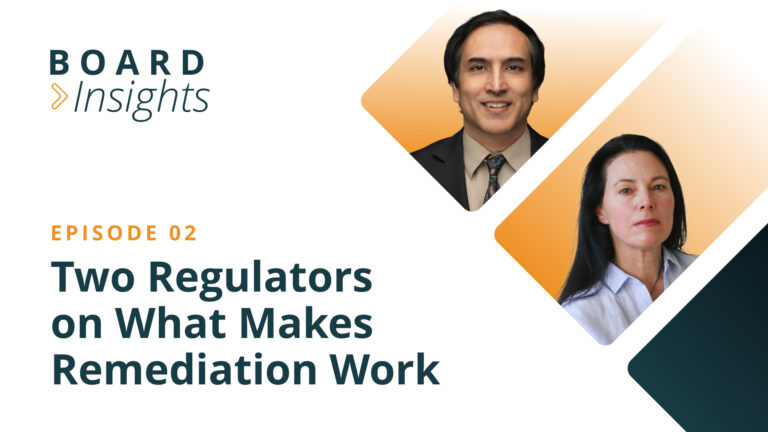
In Episode 2 of Board Insights, Ajay Gohil, a healthcare regulatory attorney with twenty-one years representing licensing boards, walks through the situations where the boards he has worked with reach for assessment. Three patterns come up, and each one is a case type where a board needs a proportionate response and does not always have one.
The Contested Case
The first is the case a board cannot resolve on the evidence in front of it. The board has the complainant’s account and the licensee’s response, and it cannot establish what actually happened. Ajay describes the bind plainly. The board is not ready to impose discipline, because the evidence does not support it, and closing the case does not feel right either. Often the board is split, with some members wanting to close and others wanting to act.
They’re not ready to take discipline, but they also don’t feel comfortable closing the case. Sometimes the board is split. That might be an instance where EBAS is appropriate.
A board caught between those options has no proportionate middle step, and that is the gap an assessment fills. An assessment does not determine what happened, and it is not a finding against the licensee. It gives the board an objective read on how the licensee reasons through the kind of ethical situation at issue, which is something the board can act on without making a determination the evidence will not support. For a divided board, a defensible step short of discipline is often the path to consensus.
The Out-of-Jurisdiction Applicant
The second pattern is cleaner, and it comes up constantly. An applicant was disciplined in another state, or is under investigation in another state or a Canadian province, and is now applying for a license where the board sits. The board cannot re-try the other jurisdiction’s case, and it cannot responsibly set the history aside either.
Here the board is making a forward-looking decision about whether to grant a license to someone who carries a record from somewhere else. An assessment gives the board an objective read on the applicant’s ethical reasoning before it grants that license, rather than a decision resting only on paperwork from another jurisdiction. Ajay names assessment and continuing education as the tools boards reach for in this situation.
When One Tool Is Not Enough
The third pattern is the one where assessment and education appear together. Ajay describes sending a licensee to an intensive education program, naming the Professional Boundaries Institute as an example, and then pairing that course with an EBAS assessment.
You might send the licensee to an intensive education class like the Professional Boundaries Institute, and then complement the course with the EBAS assessment service.
The pairing matters because it shows the two tools doing different jobs rather than competing for the same one. The course teaches. The assessment measures how the licensee reasons once the teaching is done. A board that wants both education and an objective read on whether the licensee can apply it does not have to choose between them. It can order the course to do the instruction and the assessment to do the measurement, and Ajay frames that combination as ordinary practice rather than an exception.
Why the Match Matters
Across all three patterns, the assessment fits because it is built for the case rather than applied to it generically. EBAS draws on more than 662 scenarios across five assessment domains, and a board working a boundaries complaint is assigned scenarios built for boundaries violations rather than a generic ethics prompt. That specificity is the reason the assessment maps onto the case in the first place. It is the difference between measuring a licensee against their actual situation and measuring them against ethics in general.
These three patterns are not the limit of where assessment belongs. They are the cases where its value is easiest for a board to see, because each one puts a board in a bind that a measured, objective read resolves. The boards that get the most from assessment are the ones that recognize the ethical component in a case early, and reach for the tool built to measure it.
About Board Insights: Board Insights is a conversation series from Ethics and Boundaries Assessment Services on how regulatory boards approach ethics, remediation, and disciplinary decision-making. Episode 2 features Ajay Gohil, a healthcare regulatory attorney with twenty-one years representing licensing boards, and Dr. Katrina Mulherin, former deputy registrar of the New Brunswick College of Pharmacists.