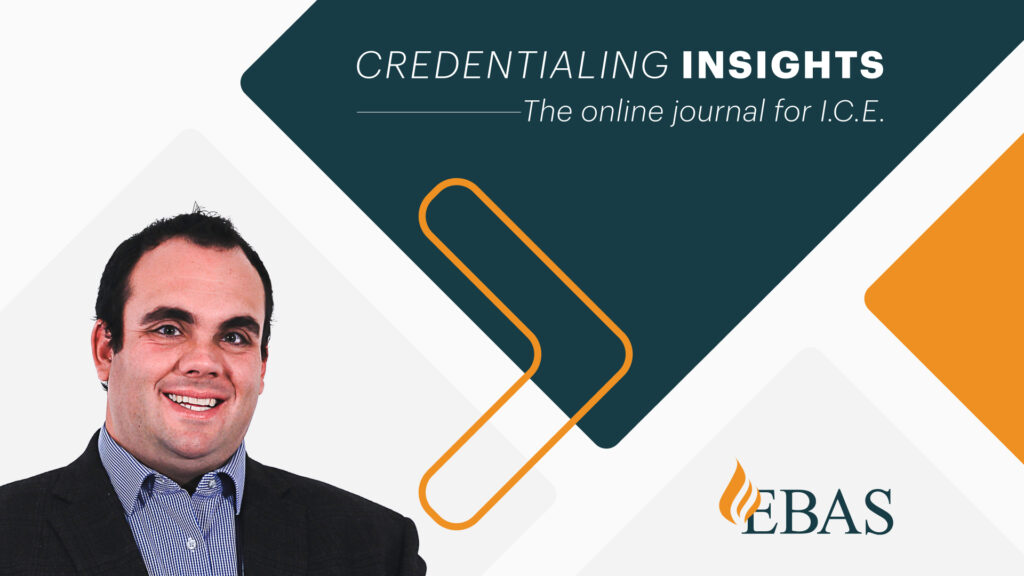
Originally published in Credentialing Insights, the publication of the Institute for Credentialing Excellence (January 2025). By Bradley Guye.
Regulatory boards and credentialing organizations share a common challenge: evaluating whether a professional can navigate complex ethical situations – not just demonstrate technical proficiency.
Traditional tools like continuing education confirm that a professional has been exposed to ethical guidelines. They don’t reveal how that professional reasons through a situation where the right course of action isn’t immediately clear. CE answers “did they attend?” – ethics assessment answers “did they understand?”
Bradley Guye’s article in Credentialing Insights examines why that distinction matters and how structured ethics assessments address it.
Why ethics assessments differ from technical evaluations
Technical exams confirm whether a professional knows the rules. Ethics assessments evaluate whether they can apply those rules when circumstances are ambiguous – when a patient asks for special treatment, when a financial incentive conflicts with a client’s best interest, or when a colleague pressures them to cut corners.
The difference is between recognizing the correct answer and being able to articulate the reasoning behind it. Essay-based assessments surface that reasoning in a way other formats cannot.
Where ethics assessments fit in the professional lifecycle
The article outlines three distinct applications for ethics assessments in regulatory and credentialing contexts:
- Licensing and certification. Integrating ethics assessment into initial credentialing helps identify gaps in ethical reasoning before a professional enters practice. The article describes a case where a new practitioner’s written response revealed a fundamental misunderstanding of confidentiality obligations – something a knowledge-based exam might not have surfaced.
- Remediation and evaluation. For professionals under review following a violation, ethics assessments provide structured evidence of whether the individual understands the ethical dimensions of their conduct. This gives boards and credentialing bodies documentation that goes beyond attestation or course completion.
- Ongoing evaluation. Periodic ethics assessment supports accountability over time, particularly as ethical challenges evolve with changes in technology, regulation, and professional norms.
Practical impact
The article notes that among licensees surveyed after completing post-disciplinary orders that included ethics assessments, more than 85% identified the ethics assessment as having the greatest influence on their professional accountability during the remediation process.
For boards and credentialing organizations evaluating how to incorporate ethics assessment into their processes, the full article is available on Credentialing Insights.