
The Five EBAS Assessment Categories
EBAS organizes 700+ scenarios across five ethical reasoning categories. Get an overview of each category and guidance on selecting the right ones for a disciplinary case.
Category Selection Determines What Gets Measured
The categories specified in a board order determine what the assessment measures and what the board can do with the results.
CASE-SPECIFIC EVIDENCE
Categories matched to the conduct produce findings the board can use.
DEFENSIBILITY
Multiple assessments across relevant categories build a stronger evidentiary record than a single assessment can.
INDEPENDENTLY VALIDATED
Each category has been tested for validity, reliability, and consistency in a peer-reviewed study of 562 scored responses.
EFFICIENT BOARD ORDERS
Orders that specify categories clearly move directly to scenario selection. EBAS does not need to circle back for clarification.
What Each Assessment Measures
Each category covers a distinct category of ethical reasoning. Boards can assign one or several, depending on the case.
Within each category, EBAS draws from a library of 700+ customizable scenarios. Once the board specifies the categories in the order, EBAS selects scenarios based on the licensee's profession. Boards can also provide case-specific context for further tailoring.
The descriptions below outline the territory each category covers. They are illustrative, not exhaustive. Boards working through a case that does not map cleanly to the examples should reach out to confirm fit.

Fraud
Ethical reasoning around financial misconduct, misrepresentation, and falsification.
This includes billing irregularities, kickbacks, recordkeeping integrity, credential representation, disclosure of financial relationships, and other situations where a licensee's honesty in financial or documentary matters is at issue.
Commonly assigned by: Medicine, dentistry, chiropractic, behavioral health, and nursing boards. This category applies to any licensed profession where financial conduct or documentation integrity is relevant to the case.

Boundaries
Ethical reasoning around professional relationships, confidentiality, and consent.
This includes practitioner-client relationships, dual relationships, confidentiality obligations, the limits of professional interaction, and other situations where the boundary between practitioner and client is at issue.
Commonly assigned by: Behavioral health, counseling, social work, nursing, and medicine boards. This category applies to any licensed profession where the practitioner-client relationship is relevant to the case.

Substance Abuse
Ethical reasoning around impaired practice, diversion, and return-to-practice obligations.
This includes practicing while impaired, diversion of controlled substances, self-prescribing, the obligations of a licensee navigating substance use, and other situations where a licensee's relationship to controlled substances affects fitness to practice.
Commonly assigned by: Medicine, dentistry, nursing, pharmacy, and anesthesiology boards. This category applies to any licensed profession where substance use affects fitness to practice.

Unprofessional Conduct
Ethical reasoning around demeanor, judgment, and conduct outside accepted standards.
This includes communication with patients and colleagues, professional judgment in difficult situations, workplace behavior, and other conduct that falls outside accepted standards without rising to a discrete violation category.
Commonly assigned by: All licensed professions.

Professional Standards
Ethical reasoning around scope of practice, standard of care, and regulatory compliance.
This includes scope-of-practice questions, standard-of-care obligations, recordkeeping, supervision, regulatory compliance, and other situations where a licensee's professional obligations to the field and the public are at issue.
Commonly assigned by: All licensed professions.

How to Choose the Right Assessments
No single combination fits every case. The guidance below reflects how EBAS recommends boards approach the decision.
- Assign three or more for reliability. A single assessment covers one scenario. Three or more establishes a pattern of reasoning that supports reliable conclusions.
- A category may be assigned more than once. Each assignment presents a different scenario within that category, providing additional insight into the licensee's reasoning.
- Set a completion window of three to six months. This is the window the board writes into the order, not how long the EBAS process takes. Most licensees complete near the end of their assigned window, regardless of how long it is. Three to six months gives adequate scheduling time without extending the gap longer than needed.
- Write the category names into the order. That is all EBAS needs to get started. The board order identifies which categories the licensee must complete. EBAS handles scenario selection from there.
Example Category Stacks by Case Type
These reflect patterns EBAS has seen, not prescriptions. Boards know their cases best.
Case type |
Common category stack |
|---|---|
|
Boundary violation (behavioral health) |
Boundaries, Boundaries, Professional Standards |
|
Billing fraud (medical or dental) |
Fraud, Fraud, Professional Standards |
|
Impaired practice (medical or nursing) |
Substance Abuse, Professional Standards, Unprofessional Conduct |
|
Comprehensive review (medical) |
Fraud, Boundaries, Substance Abuse, Unprofessional Conduct, Professional Standards |
|
Mixed violation (multiple complaints) |
One category per violation type, plus Professional Standards |
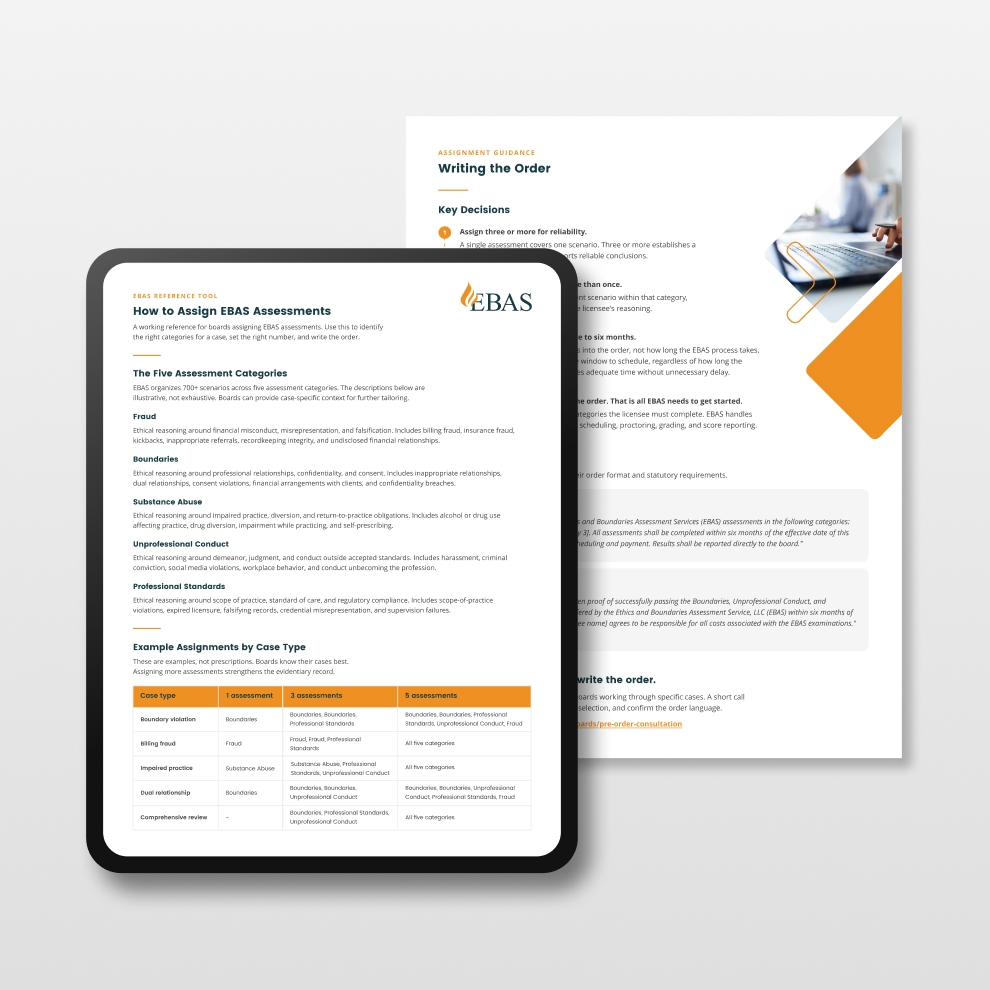
How to Assign EBAS Assessments
A two-page reference covering the five categories, recommended assignment patterns, completion window guidance, and order language. Built for admins and investigators who assign EBAS assessments regularly.
Have a Case in Front of You?
For boards working through a specific case, EBAS offers a pre-order consultation. A short call with the EBAS team to review the case, talk through category selection, and confirm the order language before it goes out.