For most of a disciplinary case, a board reads a licensee through conversation. A hearing or an interview is where the board hears the licensee account for what happened, answer questions, and present their understanding of the issue. That setting captures a great deal, and there is a kind of information it does not reach.
What a Hearing Captures
A hearing gives a board a prepared account. The licensee has had time to ready their answers, often with counsel, and the format rewards composure and a steady presentation. A board learns how the licensee frames the events and what they are willing to say under questioning.
All of that is useful, and all of it is a presentation. A licensee who reasons poorly about ethics can still account for themselves well in a room, and a licensee who reasons carefully can present badly under pressure. The hearing shows the board the account. It does not always show the board the reasoning underneath it.
What Written Reasoning Reaches
A constructed-response format works differently. It asks the licensee to think through a scenario in writing, on the page, where the work of reasoning is visible rather than summarized. In Episode 2 of Board Insights, Dr. Katrina Mulherin, former deputy registrar of the New Brunswick College of Pharmacists, describes what that written work surfaced in cases she handled.
Because of the written exercises that they have to go through, the reflections, and the application to their scenario, we gained a real sense of things. It wouldn’t have emerged necessarily at the hearing.
Katrina is describing written reflective work generally, and the principle is the one an essay-based assessment is built on. When a licensee has to apply their reasoning to a specific scenario in writing, the board sees how they actually work through the problem. The same licensee in a hearing might give a composed account that never shows how they reason when the situation is not rehearsed.
A Window Into Reasoning, Not Only a Gate
An EBAS assessment returns a pass or fail result to the board, scored against a structured rubric by multiple graders. The binary result is the output, and it is not the whole of what the format does. The essay format requires the licensee to reason in writing, which is why it reaches something a hearing does not. A hearing shows a board what a licensee says. A written assessment shows a board how a licensee thinks.
This is also the honest limit of the format, and stating it keeps the value clear. A written assessment shows how a licensee reasons through a scenario. It does not diagnose anything about the person, and it is not a verdict on who they are. What it offers is a direct look at reasoning, captured in the licensee’s own work, which a prepared account in a hearing room cannot reliably provide.
The Format Built for Reasoning
The hearing is not the problem, and it is not going away. It does the job it is built for, which is giving a board a formal account from the licensee. When a board needs to see how a licensee reasons, and not only how they account for themselves, it needs a format built to make that reasoning visible. The written assessment is that format.
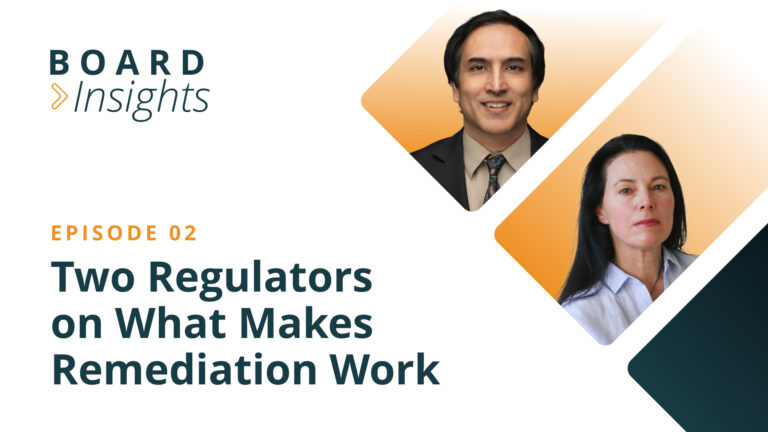
About Board Insights: Board Insights is a conversation series from Ethics and Boundaries Assessment Services on how regulatory boards approach ethics, remediation, and disciplinary decision-making. Episode 2 features Ajay Gohil, a healthcare regulatory attorney with twenty-one years representing licensing boards, and Dr. Katrina Mulherin, former deputy registrar of the New Brunswick College of Pharmacists.