Before a licensee can work through what went wrong, something has to be in place first. The disciplinary process is built to hold a professional accountable, and by design it takes control away from them. A licensee often arrives at remediation having been judged, defensive, and not yet in a position to learn. Remediation that ignores that starting point tends to stall.
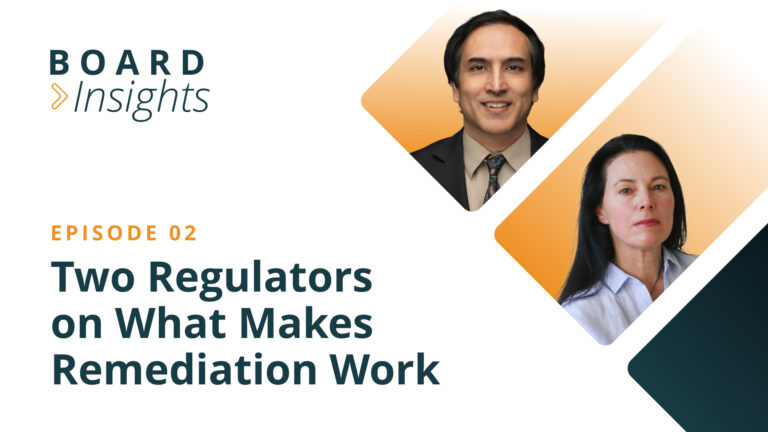
In Episode 2 of Board Insights, Dr. Katrina Mulherin, former deputy registrar of the New Brunswick College of Pharmacists, describes where she begins, and it is not with the substance of the case.
Starting From the Same Words
Katrina opens by building a shared vocabulary with the licensee.
I would start the conversations with a vocabulary that is common to both the person across the desk and me, to make sure we’re on the same playing field as far as the terminology we’re going to use to talk about the issue.
Shared terms matter more than they appear to. The licensee hears judgment in words the board means procedurally, and the board hears evasion in words the licensee means literally. Establishing a common frame first means the harder conversation that follows is about the actual issue, not about what the words mean.
Giving Control Back
The second piece of groundwork is agency. Katrina is direct that discipline takes control away from the professional, and that remediation has to start handing some of it back. In her practice that can be as simple as a choice between two or three options to get the licensee started. The choice is minor in practical terms, and it signals something larger. It tells the licensee they are a participant in what comes next, rather than only a subject of it.
Underneath both moves is psychological safety. Meaningful learning does not happen when a person feels unsafe, so a process that expects a licensee to change has to make change feel possible. Greg Hirschi, who hosts the episode, notes the same pattern from EBAS’s own experience, where licensees arrive anywhere from fear to denial, and a steadier footing changes what becomes possible. None of this lowers the standard the board holds. It builds the conditions under which a licensee can actually meet it.
A Standardized Frame as Common Ground
This is where a standardized assessment fits into the groundwork. When a board evaluates ethical reasoning case by case through subjective judgment, every participant is working from a slightly different idea of what is being measured. A standardized, scenario-based assessment replaces those competing ideas with one defined reference point. The scenarios are concrete, and the rubric is applied the same way from one case to the next.
That shared reference point gives the board and the licensee the same ground to talk from. The board is no longer relying on each member’s private sense of what understanding looks like. The standard is defined, and the licensee can see what it is rather than guessing at one that shifts case to case. A consistent standard is also less arbitrary than a subjective read, and arbitrariness is part of what makes the disciplinary process feel adversarial in the first place.
The assessment does not do the human work that Katrina describes. It does not build the rapport or restore the agency. What it provides is the common vocabulary underneath that work, so the board and the licensee are describing the same thing when they sit down to talk.
What the Groundwork Stands On
Shared language comes before change. The human groundwork builds it, conversation by conversation, and a standardized assessment gives that groundwork something firm to stand on. One reference point, defined the same way for everyone, is something the board and the licensee can both work from.
About Board Insights: Board Insights is a conversation series from Ethics and Boundaries Assessment Services on how regulatory boards approach ethics, remediation, and disciplinary decision-making. Episode 2 features Ajay Gohil, a healthcare regulatory attorney with twenty-one years representing licensing boards, and Dr. Katrina Mulherin, former deputy registrar of the New Brunswick College of Pharmacists.