Every board that disciplines a licensee eventually reaches the same question. Did this person actually change? A consent order runs its course, the licensee completes what the order required, and at some point the board has to decide whether the reasoning that produced the violation has improved enough to support a return to full practice. That decision carries weight for the licensee and for the public the board exists to protect.
For most of the history of professional regulation, boards have answered that question with judgment rather than measurement. The judgment is often skilled, and it is still an impression formed after the fact.
How Boards Have Judged Change
Recurrence is the clearest signal a board has, and it arrives only in hindsight. A board learns that remediation did not hold when a new complaint comes in, which means the information shows up after the public has already been exposed to the risk.
Short of recurrence, boards read change through conversation. A panel interviews the licensee and weighs attitude, remorse, and insight. An administrator tracks the licensee through the process and notes whether their account of what happened grows more coherent over time. In Episode 2 of Board Insights, Dr. Katrina Mulherin, former deputy registrar of the New Brunswick College of Pharmacists, describes exactly this method from her years inside a small regulator.
I would have relied on a series of conversations that were well documented. And ideally, there’s progression in terms of attitudinal shifts, and their ability to express coherently how they understand the past and how they will proceed into their future career. It was very much a qualitative approach.
Katrina is direct about what she was working without. An objective measure like the one EBAS provides was not available to her in that role. Her read on whether a professional had changed came from documented conversations and her own qualitative judgment, applied case by case.
The Limit of Retrospective Judgment
The qualitative approach is real work, and a careful regulator like Katrina did it rigorously. The limit is structural, not a failure of effort, and it shows up in two places.
The first is timing. A judgment formed from interviews and hindsight tends to confirm a problem only after it recurs. The board acts on the question late, when an earlier read would have served the public better.
The second is defensibility. An impression is hard to point to when a decision is challenged. A board that reinstates a licensee on the strength of a strong interview, and is later asked to justify that call, has its notes and its read of the room. A structured, validated assessment gives the board something steadier to stand on. Subjective evaluations are harder to defend than a documented, scored result.
What an Objective Assessment Adds
An assessment does not replace the board’s judgment, and it does not replace the human read that Katrina describes. It gives the board an objective data point on the licensee’s ethical reasoning at the moment the board has to decide.
EBAS assessments are essay-based. A licensee works through constructed-response scenarios, and multiple graders with regulatory experience score the response against a structured rubric. The board receives a defensible read on how the licensee reasons through ethical situations, rather than an impression of how they presented in a meeting. Ethics cannot be memorized. It must be measured, and a scored assessment is what measurement of ethical reasoning looks like in practice.
The boundary matters here, and stating it plainly is part of what makes the result usable. An assessment measures how a licensee reasons through ethical situations. It does not predict future behavior, and it is not a guarantee. What it provides is an objective, defensible basis for a judgment the board still makes itself, placed at the point in the process where the board most needs it. For a reinstatement decision, that point comes when the board is confirming whether a licensee is ready to return to practice.
The Same Question, a Better Answer
The question has not changed. Boards have always asked whether a licensee actually changed, and they have always had to answer it before deciding what happens next. What has changed is the evidence available to answer it. A board no longer has to rest that decision on impression and hindsight alone. It can place an objective measure of ethical reasoning at the moment the decision is made, and carry a defensible result into the record.
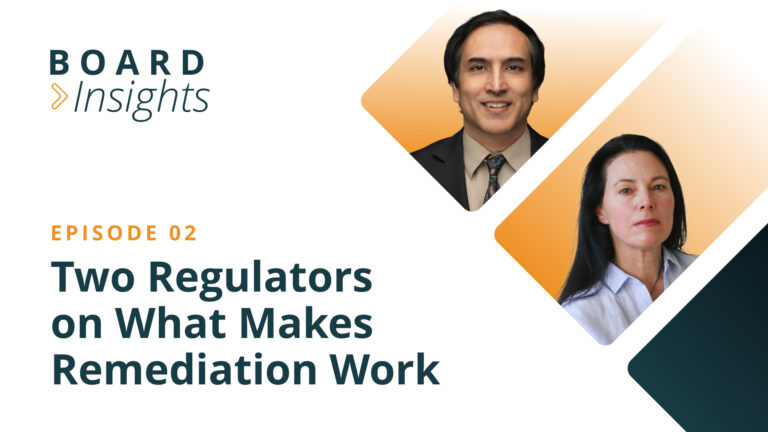
About Board Insights: Board Insights is a conversation series from Ethics and Boundaries Assessment Services on how regulatory boards approach ethics, remediation, and disciplinary decision-making. Episode 2 features Dr. Katrina Mulherin, former deputy registrar of the New Brunswick College of Pharmacists, and Ajay Gohil, a healthcare regulatory attorney with twenty-one years representing licensing boards.